To begin the story at the beginning, read "Part 1: Post 1: Beginning Again," published in January, 2013. To consult a description of the campus, read "Part 1: Post 14: The Greening of Campus," published in March, 2013.

Sunday, August 11, 2013

Part 5: Post 4: Star Watching


Location of Perseid Radiant
 You ever have one of those realizations that’s almost impossible to explain because the thing you realized is too obvious? I mean, a sudden shift in your thinking where something becomes clear all of a sudden, but there’s no way to explain it to someone else because there is no actual new information involved?

I had one of those this week. I used to wonder why we’re learning all this science stuff—not that I mind, I like ecology and physics and geology, but it just seemed a little out of place. I mean, what does geology have to do with magic? Our teachers explained it, and I guess what they said makes sense, but I don’t really get the big picture. It didn’t sink in. But then this thing clicked in my head and I remembered something I heard in a seminar way back in March, and now I’m wondering why we don’t learn other sciences.

The thing that I remembered from the seminar is that up until almost modern times, science and magic were the same thing. A lot of the ideas that we think of today as metaphor or, I guess for some, information about the spirit world, started out as scientific explanations of how the physical world works. Like Kit calls fire spirits salamanders because people used to think that actual literal salamanders, the little wet crawly things, could live inside fire. Astronomy grew out of astrology and chemistry grew out of alchemy. I’d heard some of that before, of course, but not from the perspective of someone who actually takes magic seriously.

And so the thing that went click in my head this week is that if science was once magic, then science was once magic. See what I mean? It sounds imbecilic, or at best tautological. I don’t know how to explain the light that went on in my head with those words. Ok, try this; it’s not just that early scientists did and thought things that seem definitely occult today, it’s that people involved in the occult thought that figuring out how the world works was the best way to learn magic. So if astronomy and chemistry are properly branches of magic, then why aren’t we learning them here?
Because we can’t learn everything, I suppose. I mean, I understand that if we had to gain even a passing familiarity with every area of scholarship that has anything to do with magic at all we’d all be undergraduates until we died of old age. But how did they decide on one science over another? And does anyone here actually study astronomy, even as a hobby?

I seem to have a knack for asking good questions, because I mentioned this question, completely at random, to Karen the other day, and she smiled and said that she and Joy go star-watching a few times a week, weather permitting, and that I could join them if I wanted.

So I went.

There’s a pretty serious telescope in the Herbarium, and even some of the binoculars are good enough to resolve Venus into a crescent (apparently Venus is always a crescent as seen from Planet Earth), but last night we didn’t use any of them. Instead, we watched the Perseid meteor shower.

We went to the pasture in front of the Dining Hall, because the goats and the sheep are on pasture we call the Edge of the World. They’ve been in front of the dining hall, off and on, for a while, but now they’re done with it and the grass is nice and short, almost like a lawn. Other than the sheep and goat droppings everywhere, it’s a pretty good place to lie on your back and look up at the stars. We brought some old blankets to lie on, to keep our backsides clean. They don’t have outside lighting here, and of course all the windows are dark unless there’s somebody in that room, so you get a good view of the stars anywhere on campus. The area is pretty rural, so you can see the Milky Way.

There were about a dozen of us, and we just laid on our backs and looked up. Joy pointed out constellations and told us the names of some of the stars, along with whatever random thoughts came into her head about those stars—this one is a red giant, that one is 65 light years away, and so on. Sometimes we spoke to each other, or told jokes. There was a bottle of home-made alcoholic birch beer we passed around. But mostly we just watched the sky. Shooting stars streaked here and there, some short and dim, others long and bright. A lot of the time I was looking in the wrong part of the sky, which was frustrating, but I got lucky some of the time. Whenever anyone saw a shooting star they said “there’s one!” and pointed, which was a pretty pointless thing to do, since it was usually gone by the time the rest of us turned our heads, but we all did it anyway. There was probably one or two a minute, Joy said that’s normal for the Perseids, but of course we didn’t see all of them. I think all of us fell asleep for a while, at one time or another.

I’d heard, years ago, that meteor showers are comet dust—when comets go around, they leave a trail of dust, and when Earth passes through that trail the dust burns up in our atmosphere as a lot of shooting stars. I don’t remember where I learned it, I learned it so long ago. I’ve always wondered if that means it’s possible for the comet itself to hit Earth, one of these times around, and I think it is, but nobody else seems worried about it. Anyway, Joy says the Perseids are the trail of Comet Swift-Tuttle.

The Stars of Perseus
Karen didn’t say much. I don’t think she ever says much, except in class, but once, after an especially bright meteor, she did give an appreciative “oo!” and then she spoke.

“You know, they used to think it was scientifically impossible for rocks to fall from the sky to Earth. Remember that, whenever anyone tells you about what can and cannot be done.”

I like that. What I do not like is waking up stiff and cold in the middle of the night. We fell asleep and lay out there until nearly three in the morning. Remember when I said I thought it was still summer, Kit’s ritual year notwithstanding? I was wrong. It’s fall now.

[Next Post: Friday, August 16th: Lying to Lambs] 

Friday, August 9, 2013

Part 5: Post 3: Nagasaki Day


Today is Nagasaki Day. Earlier this week was Hiroshima Day. I mean the anniversaries of the days we dropped atomic bombs on Japan.

I never paid much attention to these days, except once when I was in fourth grade my class did a big thing on it and we all learned how to make paper cranes. There was a girl we learned about who had been a baby in Japan when the bomb fell and several years later she got leukemia, from the radiation. She started folding paper cranes because someone told her that if she folded a thousand she would be granted a wish. Her wish was to not have leukemia anymore, to not die. She became famous for folding hundreds and hundreds of cranes, but she didn’t make it. She died before she reached a thousand. Her friends kept folding, after she died, and she was buried with a thousand paper cranes.
I don’t know why they told us this story. To me, it seems just pointlessly sad.

I asked Greg about this—I happened to be in front of him in the line for the bathroom the other day. I hardly ever know what to say to him, he seems so severe, but I knew he was going to give a talk on the bombings. So I told him about that day in the fourth grade, just to have something to say, for once. I guess I wanted to show I’m not completely ignorant, also. He smiled at me, a little, but he looked sad, too. There is something very human, very gentle, about Greg, when he expresses any emotion, though he usually doesn’t. Usually he’s as austere as a rocky crag.

“People will do all sorts of things to gain a sense that they have some kind of control,” he said. We both stepped forward a place in line. After a moment he spoke again in a different, lighter tone; “it is true that after all those cranes were folded she didn’t have cancer anymore.” I looked at him in something like shock and he grinned at me for a moment. I couldn’t decide if his comment counted as a sick kind of humor or something very compassionate and profound. We both stepped forward again, and his expression faded to its normal neutrality, his teaching face. “There is something very alchemical about that crane folding. Japan is a Buddhist country, you know, alongside Shinto, and there are a lot of Buddhist stories about people meditating for long periods or performing various extreme ascetic exercises and being granted boons, magical powers. It’s possible that’s where her idea of folding so many cranes came from. But magic is a funny thing; magic, real magic, always transforms something, but it is impossible to be sure what will be transformed. Consider that when I mention the Hiroshima bombing, your first thought was of a little girl with cancer who did not want to die. That’s not the message I got, when I was a boy.”

And then it was my turn for the bathroom so our conversation was over.
Greg’s talk was after dinner, during the third class block, when most talks are scheduled, except that we met outside on the pasture by the dining hall, so as many people could come as wanted to. So we sat and listened to him as the sun started to set and the shadows grew long and we slapped at mosquitoes. When a mosquito bit Greg, and I could see this from the front row, he did not slap at it or wave it away. He just experienced it. 

He told the story of the bombings the same way he had told the story of the Revolutionary War, back on Independence Day. He talked about human beings going about their lives. He talked about historical controversy, and the different interpretations of how and why nuclear weapons were used as they were, but while he added some background information for and against certain interpretations—just like back in history class he seemed interested in how we know things, how we decide which versions of history are reliable—but he didn’t seem particularly attached to any one story. But then he did something he could not have done for his talk on the Revolutionary War. He talked about himself.

“In 1945, I was eighteen years old. I had dropped out of school and had a job as a carpenter, so I could support my mother, but I wanted to go to war. As an American, I loved my country. I hated the Japanese. I had friends” –and here his voice cracked and he swallowed, convulsively—“I had friends, older boys, who didn’t come home from the war. I wanted to fight, I wanted to prove myself. When the bomb was dropped, I was happy. We all were. According to one poll, almost thirty percent of Americans were sorry when Japan surrendered, because they wanted to drop more atomic bombs. They wanted to kill more Japs.”

His use of the derogatory startled me and I looked up at him. That’s when I saw him bit by the mosquito. He ignored it. He paused a moment before speaking again.
“The problem was, I was a Jap.”

News to me; I had always assumed Greg was white. Or, rather, I had never thought about Greg’s racial identity one way or the other. I don’t usually think about race, unless somebody brings it up. His last name isn’t Japanese, and he looks mostly white. I guess there’s something about his eyes, but he usually wears glasses.

“My mother was an immigrant, but she was very young when she came over,” Greg continued. “She largely assimilated, and of course my father was white. We didn't live near other Japanese people. So, other than my being raised Buddhist, there was nothing about my childhood that was culturally different from that of my white counterparts. There was no reason for me to take any special notice, to identify with, the people of Hiroshima and Nagasaki, or with those of Tokyo, which was fire-bombed with conventional weapons to similar effect”—

“No more reason than for me to identify with Dresden,” put in Allen, who was sitting off to the side. His ancestry is partly Germanic, though he’s also much too young to have been alive during World War II. Greg acknowledged him with a nod and then went on.

“But anyone who saw me, or especially is they saw me with my mother, to them I was alien. All throughout the war. We did not have to go to the camps, because we lived in the Midwest, but we knew people who did. We watched the news. We knew what was happening. We become, to some extent, what other people perceive us to be.” He paused again, and took off his glasses. The light of the setting sun shone on his face for a moment and he squinted, then stepped a foot or two to the side into the protection of a lengthening shadow. He continued.

Greg
“I am an alchemist, among other things. Alchemy is about transformation. Famously, it involves transforming less valuable substances into gold, although gold is the least important, and least interesting, of the things alchemy can actually do. But transforming one substance into another on an atomic level is not impossible. It has been done. It was done in Hiroshima, and, a few days later, it was done again in Nagasaki. A few hundred pounds of uranium were transformed into various fission products. But one principle of magic is that by transforming one thing you also transform other things, since all things are connected.  And so those explosions, and the war that precipitated them, transformed American me into a man who is, at least in part, Japanese. I became a devout Buddhist, and ultimately a Buddhist teacher, because I needed to find something in my heritage I could claim, instead of having it thrust upon me because of the way I and my family look.”

I expected him to say something else, to wrap up his story with some kind of definitive conclusion, even a moral, but he did not. He just stepped off the small, portable stage and into the crowd. After a few long seconds, we realized he was done and the talk was over. The sun went down and we all went to bed.

[Next Post: Monday, August 12th: Watching Stars]

Sunday, August 4, 2013

Part 5: Post 2: Harvests and Classes


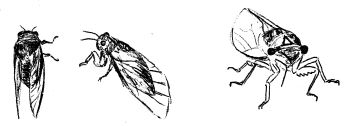
Cicada
So, both academically and ritually (at least according to Kit), it is now Fall. Being as everything is green and most days are still hot I’m not sure I buy this, but whatever. It is a different kind of summer than it was a month or two ago, I will acknowledge that. The grasses and other plants flowering in my plots are entirely different, an almost complete turn-over. I don’t hear as many birds anymore, but there are cicadas and what I guess are grasshoppers. At night there are crickets.  The farm is in full swing, too, both in terms of the variety of produce coming in and the amount; the food, as I mentioned, is fantastic, and there is way more than we can eat. They're drying and canning like crazy--it's a strange thing to watch a winter's worth of food slowly accumulating, to see horse-carts full of tomatoes heading off to the drying racks (they don't have a pickup truck) or walk in the Dining hall for lunch and the who place suddenly smells like drying onions and to know that's what you'll be be living on a few months down the road.

The summer camp is over. First the shrieking stopped, right before Lammas, and now the tents are gone from the orchard. Most of the sprouts are still on campus, but they're quieter...and they're not outsiders. They stay over sometimes, though I'm not sure where they sleep. Maybe they bunk with the masters or something, though if they do they know the trick of going in and out of the fourth floor without any of us seeing. 

Grasshopper on Flower
Sometimes I see Allen and his kids arrive on campus. They bicycle in just before lunch on Tuesday. Usually it’s just the older two, Julie and David, but sometimes Alexis rides in a kid-carrier on Allen’s bike. They all stay through until Friday night or Saturday morning, building tunnels and forts among the shrubbery or running all up and down the mountain ridge behind the campus. It looks like a lot of fun.

The reason Allen comes in on Tuesdays is that his first class of the week is Tuesday afternoon. I'm in that class, though it hasn't actually met yet. The official name for it is “Lies, Statistics, and Illusions.” Among other things, it’s apparently about how to avoid being manipulated by advertising, so I've heard some people call it "Defense Against the Dark Arts," a Harry Potter reference, of course. It’s a popular Allen’s classes are.

Charlie’s classes are usually less popular. I suppose that’s what happens from growling at people the way he does. I signed up for two, though—Messing Around Outdoors, and Environmentalism for Dummies. The former actually is pretty popular; it’s basically several classes worth of field trips but without much in the way of lectures or homework. He teaches a version of it every semester, and a lot of people take it more than once. The other class is probably more important but less fun; learning some of the science behind environmental issues, like why species go extinct. The “for dummies” part is probably a reference to the fact that a lot of students here really aren’t that interested in science--something that seems stranger and stranger to me the longer I'm here. I guess Charlie's ideas are rubbing off on me.

Field Cricket
My fourth class is a physics class called “Complex Systems,” and I don’t know what it’s about, not really. But I like the physics classes, and I have to take some of them, and this one comes recommended by several other students, including Rick. 

So, another semester, another set of classes—except this time all the classes are electives. We still have to take a certain number of credits in each competency area, but from here on in I get to choose which ones I can take. So I’ll be in class with senior students as well as other yearlings, and I'll be learning things not all of the other students will learn. We’re drifting further apart, further into our own individual courses of study. We're still yearlings, technically, because we're in our first year, but from here on in that doesn't matter much, practically. A shift has taken place. 

This semester is also the longest, at ten weeks. That’s still not very long—all the classes this time are three credits, so that’s twelve class meetings, and the extra meetings have to take turns occupying Wednesday. But it’s long enough. When it’s over, so will the school year be, and all this riotous green will be gone.
Cicadas

[Next Post: Friday, August 9th: Day of Transformation]

Thursday, August 1, 2013

Part 5, Post 1: Lammas

Lammas is August 1st. It's a kind of harvest festival, apparently. Actually, most of the people here call it Lughnasadh, but I'm told Lammas is a perfectly acceptable alternative name, and it's much easier to spell.

Tomato


I'm not sure how big a deal this holiday really is. Not a lot of people talked about it ahead of time--there wasn't a lot of anticipation, except maybe for the feast itself. I'm not even sure what it's about. But it is a day off between one semester and the next, and we did have a big buffet lunch out in a tent in the pasture near the Dining Hall. I liked it, I know that.

I really liked the food. I always do, pretty much, especially since we've been getting fresh fruit and vegetables every day. The cooking is good, I suppose, I certainly have no complaints, but really the excellent food is Sarah's doing. Everything I've had that comes from the farm here is the best of that vegetable I've ever had. Today I was eating stuffed squash--and enjoying it--and I don't even usually like squash. The feast was kind of a way to show off everything Sarah could do, but she didn't really stand out personally at the party. If you didn't know she had made it all possible, you wouldn't know. The party went on for hours. There was a bit of a performance--they made a low stage out of black boxes and had a sort of open mike for about an hour. Then we just hung out and talked. Some people brought guitars or juggled, or just sat around and read. One girl--woman--took a nap under a table.

Oddly, we didn't have to wear uniforms, though some people did anyway. I guess it was too hot. The hot-weather uniforms don't actually look that good. I'm glad they let us be out of uniform, whyever they did it--because I got to see Kit in what is, I guess,her own ritual outfit, the one she wears for her coven's ceremonies. I got to see her sing, too,not for the first time, but I don't ever take her singing for granted.

Kit's ancestry is mostly Greek, I've gathered, though she doesn't look it, because of her coloring. But she has a Greek last name and I guess she identifies strongly with that part of her heritage. Her outfit looked vaguely like something you might see on a Greek statue, this long, white dress with these light, loose layers. She had a belt on over it, I don't know if the belt was Greek or not, maybe it wasn't. It was made out of the wide brass rings linked together with big turquoise beads, so your eye went to her hips when she walked. She wore a cape, a bit like the uniform capes, but dyed green on the outside and red on the inside. When she sang she danced a little, just swaying with the music, mostly, and her dress and her cape swayed as she swung her hips and shoulders and the brass bangles jangled on her arms. I swear, every movement that woman makes she makes on purpose, precise as if she were following invisible marks in the air.

She sang "Harvest Moon," by Neil Young, a song I've never really liked, because I don't like Young's vocal style. It sounds whiny to me. But I like the song now. The music and the lyrics are still stuck in my head, but jumbled, because I don't have them memorized. Let's go dancing in the light...full moon rising...because I'm still in love with you, I want to see you dance again...on this harvest moon.

Allen sat behind and beside her on the little stage and played his guitar to accompany her. He played well, I thought, though he seemed to be really concentrating. He spent the entire time watching his hands as he played, to make sure he got it right, I supposed. He didn't watch Kit. I think he's the only one who was there who didn't.

The masters didn't stay much after the performance, though. They all left early, but they didn't leave at the same time. They slipped out, one or two at a time, like we weren't supposed to notice them going, and the only reason why I noticed is that I watch people. For whatever reason, that's what I do. I don't just watch Kit, I mean. I watch people normally.

I happened to be watching Greg when he left. I’d been watching him much of the afternoon, because I was surprised he was there; Greg doesn't usually attend community events if he doesn't have to.He holds himself apart. But today he seemed to be in an unusually good mood, joking and laughing with some of his friends. Then he left, just stepped out and didn't step back in again. I was watching the door to the tent, thinking, when Allen left. Odd. Were they going somewhere together? I knew they got along, but Greg seemed so separate from the others, it seemed strange to think of him making plans with somebody. I decided to look around and see who else had left, and I noticed Joy was gone, as were both Joes and Chuck, the maintenance man. Obviously the masters were going to do something as a group that we students weren’t supposed to know about. I debated asking one of them directly—a direct question usually got an answer, and the masters sometimes did things mysteriously in order to provoke students into asking. But they also sometimes acted mysteriously for the pleasure of being mysterious, and I wasn’t sure I wanted to spoil their fun—or mine.

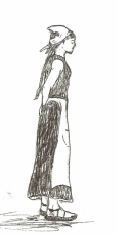
But I got distracted from any snooping or questioning I might have done that day, because Kit and Sarah started singing. They weren't performing. Maybe they were practicing. They were off by end of the big tent, by themselves. Sarah was sitting on a tall stool, Kit was standing. Kit had changed her clothes--maybe she didn't want to wear that wonderful white dress to eat--and had on a green dress with mirrored flecks sewn in that set off her hair, just so. Sarah wore one of the simple, grey skirts she sews herself, and she had her hair done up in a yellow bandana. And they sang "I Come to the Garden Alone," Sarah in a sweet soprano, Kit weaving her earthy alto in and among Sarah's tune.

I went over to listen to them--Kit looked at me briefly, nervously, but otherwise they both ignored me, which was fine with me. I would not have thought they were friends, except for these occasional duets. They were both so zealously committed to religions that each excluded the other, not that Christianity and Wicca have to exclude each other, obviously, but that's more or less how both of them do it. And yet they sang duets. I've heard they were once close, when they were students.

Finally, they stopped, embraced, and Kit began to gather her things to leave. Sarah sat down next to me, but she was looking off behind me, watching something. I turned, and saw she was watching Charlie. Here eyes followed him as he gathered his things, spoke briefly to a few people, and left the tent.

"You were his student, weren't you?" I asked. This is common knowledge, but I was being conversational. Also I was being nosy. I wanted to know about the strange, almost but not quite neutral expression on her face as she watched him. She blushed, slightly, but whether it was because she'd been rude enough to completely ignore me (Sarah was usually very conscientious and polite), or because I'd clearly noticed her watching Charlie, I couldn't tell.

"I still am," she told me, quietly.

"Did he always make it so hard to be his student?" He had just made me re-label several dozen trees again, so I was a bit irritated, but Sarah clearly thought I meant his resistance to taking on students to begin with, which is legendary.

"Oh, no. He used to be pretty outgoing, to a fault, if anything. He seemed to think he was God's gift to students. He couldn't wait to teach us."

"Really?" I'd never heard of this. "What happened?"

"If he has not told you, I will not."

"Well, what else was he like? What was he like when you were a candidate?"

"He knew everything, same as he does now," Sarah smiled nostalgically as she spoke. "You know how your parents seem to know everything when you're small? He really did. He made the world seem bigger."

"I guess you're like Allen, then, stuck between him and Kit?" I shouldn't have asked about this, and Sarah shot me a look, but I think it's common knowledge that Kit and Charlie are more or less allergic to each other. But Sarah shook her head.

"It wasn't like that. We were his students together. I found my way to Jesus through him, and she found her Goddess. She admired him as much as I did,"

"What happened?"

"We both grew up, I think," she answered. I must have asked too many questions, though, because Sarah nodded to me in farewell, and abruptly got up and left. It was a self-protective gesture so like Charlie that if I didn't know better I could have sworn she was his daughter.

Sarah


[Next post: Monday, August 5: Harvests and classes]

Sunday, July 28, 2013

Fourth Interlude

Hi, all,

Daniel-of-2013 here.

It's been surprisingly difficult to not write about our daughter. She's really occupying a huge part of my available attention. It reminds me a little of when, in graduate school, Rick used to call me up and ask how I was doing and I'd tell him all about my homework assignments. I had no inner life to talk about. My life was in my books and my laptop and my notes, so that's all I had to talk about.  Now people ask me how I'm doing and I tell them how my daughter's doing. I'm one of those Dads. And then I sit down to write this blog every week and I have to change gears, cast my mind back, and become again, as much as I can, that boy who had no child, who loved no wife, who was hardly more than a child himself.

It feels like a very long time ago, and yet...I can still smell the rain through the open balcony door in my mind. Part of me has never left, and probably never will.

Of course, had I never been at the school there would probably be nothing funny or remotely telling about my inability to answer a question like "how are you." I have friends, mostly other men, who can't ever answer the question, and I probably would have become one of them. I'm just not an introspective person. I don't think I'm any more self-deluded than the next person, and it's not that I have no inner life, it's just that I don't pay much attention to my inner life because, basically, I think I'm pretty boring.

I've been told that not trying to understand myself is a bit like trying to use a map without first locating oneself on it, and that makes some sense. My wife keeps telling me that if I don't tell her what I think and feel then she won't know what makes me happy, and she really gets a kick out of trying to make me happy. That makes sense, too, because I'm the same way about her. But making sense is not enough. I wouldn't be able to say how I'm doing if I didn't know how, and Allen is the one who taught me. Allen and Greg.

Allen taught me to name my feelings. He taught all of us, to one degree or another. I remember someone (I no longer remember who--it may have been Oak) insisting that he was not angry about something and Allen asking him to describe his current physical sensations and mental imagery. When he had, Allen explained that this was anger. The other man had thought anger meant shouting or trying to hurt someone. He hadn't known there was a difference between feeling and expressing.

Greg taught me to find that difference. After months of zazen it was like...sometimes I became aware that I was watching myself. Not analyzing myself or thinking about myself, just watching. It only happened occasionally, and it was very faint...since then my observer-self has gotten much stronger. I'm not wiser or smarter than I used to be, but it's like I am less caught up in my foolishness and stupidity. It's hard to explain.

I remember how I thought when I started at school--and I think I was fairly normal at that point. I was maybe a little young for my age, but basically my reactions to the school were about the same as I think anyone's would have been--wonder and confusion mixed. But by the time I had been there for five or six months I was no longer normal. I had become more self-aware, more curious, and slightly more intellectual. My basic assumptions and reactions were changing. I mentioned, in my last post, the day I biked into town to buy a Coke and ended up regretting it. Part of the reason I regretted it was that I had the bottle to deal with afterwards. Well, I can imagine the reader asking, how difficult is it to recycle a Coke bottle? But this is a case in point of how I had changed. I didn't see that bottle as a piece of trash anymore, I saw it as an object in its own right, a piece of plastic that could and should be used for something--and I couldn't come up with any need for it. It felt like such a waste. How do I describe this?

How do I describe the man I was becoming, when he had so little in common with many of my readers? Of course, some of you probably avoid excess packaging, too. I wasn't the only person in the world concerned about packaging, meditation, or even the child-rearing practices of cultures in southeast Asia, or whatever I was reading about in Anthropology class that week. But now, when I buy a bottle of soda and feel bad about wasting the bottle--and I still do this two or three times a year--I do it in the context of a society where single-use bottles are considered normal. I have it in the back of my head that I'm a little unusual. When I was at school, though, I was entirely inside a society where nothing is ever used just once and where, when people ask "how are you?" they really want an answer. I changed largely without knowing I was changing, or without knowing the depth of the changes. I did not realize I was strange. And it is that innocence I do not know how to describe.

While I'm setting the record straight on things, I should say something about the logistics of course registration and grading at the school. It's not deeply important, and I haven't found any place in the narrative to put it, but you may be wondering how we did it.

Mostly course registration was already computerized when I got there. Hardly anything else was. The school was slow to enter the electronic age--even by the time I graduated, in 2004, there was still no expectation that students own computers. There was no school email system and no way to get online except by the six desktops in the computer lab, which was basically a hallway on the first floor of the Mansion. At least the lab was always open, so you could work at night, if you needed to. But we did have the most amazing program to manage our courses. I've never seen anything like it since. You'd type in your name and get a spreadsheet of sorts that already knew your various prior commitments and course requirements and it would fill in most of your schedule automatically. You'd just have to pick an elective or two or sort out a conflict. The whole system ran smooth as silk and never crashed. The faculty must have had something similar because they didn't seem to have any trouble getting us our evals on time. And I have no idea who managed all of this. At the time I was a novice, there was no IT person on staff. It was just one of the mysteries of the place. I didn't appreciate it at the time, because I had so little to compare it too, but now, in retrospect, it seems as miraculous as Hogwarts' house-elves.

Anyway, I'm about out of things to say, for now. I hope you have a wonderful Lammas.

Friday, July 26, 2013

Part 4: Post 12: The Storm

At home I used to sleep with the air conditioner on in the summer, or a fan, most of the time. When I did have the window open I mostly heard traffic, or the neighbor's TV. I don't come from a big city or anything, but the area's not exactly rural.

Green Frog
 Here, though....we have no air conditioning. We have no fans. Sometimes it's hot at night, but mostly it's alright, because of the way the air flows through the building at night, in through our open balcony doors and up and out through the skylight at the top, in the master's courtyard. I worried some about mosquitoes, and I thought about getting some mosquito netting--some people have it--but not very many of them fly up here to the second-floor window.

And through that opening....

I hear rain on the leaves of the bean-vines, soft, because most of the drops are blocked by the balcony above. Just some drift in, land on the leaves--I still have to water them in the morning. When the rain starts I wake to the sound and the cool, green rain-smell washes in from the window and over me. Sometimes I can hear frogs breeding in the little pool in the Bird's Garden behind the Mansion or the water-feature in the corner of the Formal Garden inside the white cedar square. Once I heard coyotes calling, a rising, multi-voiced sing-song out in the woods, and the sheep and goats and horses called back nervously and the dogs all started barking. The coyotes ignored them all and sang on.

Could I have hears any of these sounds at home? Well, not the horses, obviously, but the others? Maybe. But I wasn't listening. I tuned out sound when I slept, the hum of the fan or the air-conditioner, the sounds of traffic and my neighbors. I learned not to listen.

I biked into town today during lunch. I don't know why, but I was really craving a Coke. I hadn't had one in months, and I just really wanted one all of a sudden, so I biked in and got one, plus one of those stupid little muffin-thingies you get in convenience stores and a Snickers bar. That was all my lunch, since when I got back to campus it was time for class. And the Coke...it wasn't as good as I remembered. Come to think of it, I'm not even sure I really used to think Coke was all that good to begin with, though I drank a lot of it. I don't know why I was craving it. And then I had the stupid bottle to deal with. I'm not sure I'll bother getting any again.

Bean Flowers
Anyway, so the reason I'm bringing up my misadventure with Coca-Cola is that on the way there I smelled new-cut grass and also lighter-fluid. It was a nice day, and people were out mowing their lawns and someone was having a cook-out. And that smell--it totally took me back.

My Dad's a serious grill-freak, and almost every weekend in the summer we used to have cook-outs, the whole time I was growing up. I learned how to grill a steak properly before I learned to boil an egg. It's like my whole childhood--being outside in the summer just smelled like cut grass and lighter-fluid. And this is the first time all summer this year I've smelled it. It's not that we don't have cook-outs--there's Philosopher's Stone Soup, of course, and there's usually somebody cooking dinner outdoors. It's that we don't use lighter-fluid because we don't use store-bought charcoal.

We don't use lawnmowers, either, though our neighbors do, so we do get that smell. But here the summer mostly smells like...animal dung. It's not gross--it doesn't smell like sewage or anything. It's just a sort of musty scent, not very strong, just sort of there. They use mobile electric fences--they're solar-powered--to move the grazing area around whenever they need to. When they run out of campus to graze I guess they leave the sheep and goats and horses in their paddocks and give them hay until the next time the grounds need to be mowed. They've been right around the Mansion the last few weeks, and before that they were between Chapel Hall and the Dinning Hall, so there's this faint smell sometimes. The chickens wander everywhere--there are two flocks, and each one gets to be completely free-range every other day, so if something does eat them we won't lose all our eggs at once. So add that to the list of sounds and smells--the crowing. It's not loud--I can sleep through it--but, again, it's there.

The summer has been pretty quiet, so far, not a lot of storms, but no serious drought, either. I've heard last summer and the summer before that were terrible for drought, and some of the crops failed. Sometimes I see flashes, or hear a rumble or two at night.

But today--I'd just gotten home from class and I was about to shower for dinner when one of the Ravens knocked on my door.

"Storm's coming," she said, and went on to the next door. We don't watch the weather reports here, but some people are really aware of the sky and can give a pretty good prediction a few hours in advance. I went out on my balcony and peered through the beans and I could see that the sky to the west was all dark. The bean leaves moved beside me, fluttering in the sudden, cooling breeze.

Obviously, I could not shower, but it wasn't my turn to prepare dinner, so I moved my chair to the balcony and watched and worked a bit on my homework.

And the sky just got darker and darker. After a few minutes it was like the sky exploded--pouring rain, lightening, wind. It was really something. And it just went on and on like that. I probably should have gone inside, but instead I looked out through the beans again and I could see the wind whipping the tops of the oaks and hickories and the locust grove we call the Enchanted Forest. My face was wet in a minute.

"That's one way to take a shower," said Raven behind me. I hadn't heard her knock. She had come back to my room. She'd come back to tell me that no one could get out to the Dining Hall to pick up the meal, and did I want to eat leftovers now, or wait until the storm was over so we could pick up fresh food?

Bean Vine
"Well, when is the storm going to be over?" I asked.

"Tuesday."

"Oh, get out."

"I'd say an hour or three. It's a long storm."

"Leftovers sounds good to me. You know half of us will snack on leftovers anyway, if we decide to wait."

So, that's what we did. An advantage of being off the grid is that we never lose power in storms, but we decided to eat by candle-light anyway. It was nice.

Monday, July 22, 2013

Part 4: Post 11: The Failure of Reason

 Well, I missed it. Just the day after I posted the last entry, I was sitting there, watching the phoebe nest, doing my homework...and I looked down at the book I was reading and when I looked up again the nest was empty.

Dang.

I didn't entirely miss the show, though. Otter, one of the senior students in my dorm, happened to be walking by while I was sitting there dumbfounded, and he saw my face and asked what was wrong. I laughed, because I felt kind of silly, being upset about having missed the birds flying away, and then I told him. He just looked around for a minute.

"No, you didn't," he said.

"Didn't what?"

"Didn't miss all the birds flying away. There's one--see?" And I looked. There was a little bird perching on the edge of the large lantern that hangs over the steps that go up to the front door. The best way to explain it is to say that if you look at a picture of the front of the White House there is a similar lantern, but bigger, hanging there. Only, I've never seen ours on. I don't even know if it works. Anyway, there was a little bird clinging there.

"But it doesn't look anything like a phoebe," I protested. "The tail's shorter and it's all...weird-looking." Otter laughed. As the name implies, he's interested in and knowledgeable about animals.

"Of course not," he told me. "You're used to looking at the adults. This thing was a chick an hour ago. Songbird fledgelings all have really short tails. And it's all weird-looking because it has no idea what's going on. If you were only sixteen days old and had just discovered you can fly, you'd be weird-looking, too."

As we watched, the little phoebe fledgeling whistled for its parents, who didn't come. It flew around the inside of the carport for a bit, seemingly lost, and I could see it breathing heavily at one point, when it landed near me. It did, indeed, seem confused. But just when I was starting to worry that it might need some kind of help it suddenly got up and flew unerringly away. So now they really are all gone. I don't suppose I'll ever see any of them again, and I don't think I'd know them if I did. I'll have to keep an eye out for short-tailed songbirds.

I'm going to miss watching those birds, though I suppose it's just as well--I was starting to fall behind on my homework. I'd like to know more about birds, the way Otter and some of the others do. I'm starting to want to know about everything. At least I am learning about trees. I thought I knew all the trees on campus weeks ago, but I would have forgotten them. Now, I don't think I'm going to forget. I've filled out those stupid labels so many times, over and over, the same species sometimes many times a day (Charlie tends to unlable whole species at once,so I'll wake up one morning and find hemlocks, red maples, and white oaks unlabeled. A few days later it will be black cherry, white pine, and alternate-leafed dogwoods). It's like a chant for each species, a discipline.

Hemlock Twig
 Eastern hemlock, Tsuga canadensis; Eastern hemlock, Tsuga canadensis, Eastern hemlock, Tsuga canadensis. Greetings, Eastern hemlock, Tsuga canadensis, thou conifer with short, uneven needles and reddish, wrinkled bark! Hail thee! Of course, I don't actually say that. I greet them without words. But that's what it's like. I expect I'll be dreaming about them, soon. Maybe when I do, Charlie will know somehow, and he'll let me stop.

I'm not worried about it, though.

I was worried about Ollie,earlier this week. Something had been going on with him. He seemed distracted, grumpy, just...stressed. It wasn't like him. I usually let people do their own thing, unless I'm feeling nosy, but Ollie's a good guy and he's helped me out a lot. So I asked him about it the other evening. At first he wouldn't tell me, but he didn't actually say he didn't want to talk about it. Instead he was trying to brush me off without admitting that he was doing it, and it kind of pissed me off. I mean, if you want me to go away, be a man about it and say so. So I kept following him around the dorm, pestering him, until finally he threw himself down in one of the chairs in our lobby.

"Ok, then, sit," he told me. He sounded tired. With a gesture I indicated the other people in the room, all reading or writing busily--maybe two or three of them. He waved off my concern. "They're reading.They're dead to the world. And I don't feel like getting up." He's probably right not to care--people mostly mind their own business here. There's hardly any rumor mill at all.

So I sat down to listen.

"Daniel," he began in a low, stressed-out voice, "there's a girl who wants to have sex with me."

"What?" I was confused--first, I was distracted by his wording--no one here says "girl" for grown women anymore, and Ollie's really careful about that sort of thing. So the way he said it just sounded weird. But it was obvious what he meant. But still....huh? The people reading in their chairs had not moved. The word "sex" doesn't attract much attention here, because most people talk about it openly, not like people talk about it in other places--it's like it's no big deal for a lot of people. But Ollie's an exception. He doesn't talk about it, usually.

"There's a girl who wants to have sex with me," he repeated. "Quite a lot, actually." He blushed and looked away.

"And this is a problem why?"I asked him. He took a few seconds to answer.

"You've got to understand how I was raised," he told me. "My church takes no sex before marriage very seriously. You're not even supposed to think about sex. I got so used to never even looking at a girl from the neck down I think they actually could have been naked--I wouldn't have noticed. Jesus said that to look at a woman with lust is to commit adultery in your heart. So, obviously you can't have lust...except, how can you not?" he blushed again. "It's just a particular cross to bear for adolescent boys."

"So, what did you do? As an adolescent?" If he had some kind of cure for inconvenient lust I'd like to know, after all.

"I took a lot of cold showers," he answered. He smiled a little and then continued. "I'm not the only person here who was raised Baptist, but I think I'm the only one here who still is Baptist. I see things differently than I did when I was a kid--I'm not as reactionary, I'm not as literalist. I don't think a passing thought or feeling will condemn me to Hell, anymore. God gave me this body and these feelings for a reason. But I have to be a man about it and not a beast. I can't just do things because I feel like doing them. I...believe in celibacy before marriage. I believe in doing what I know, in my heart, is right."

As he talked, I saw Ollie's body language change. When he talked about how he was raised, he looked like a boy. He looked shame-filled, like somebody was doing something to him. A victim. But as he talked on he grew older. By the time he got to that last line he was an adult again, confident, with this quiet, unshakeable integrity. It was strange and touching to see. Then he sighed.

"But loving Willa is also right. And I don't know what to do."

"Willa? You're in love with Willa?" I asked. I hadn't thought of them as together, though I knew they were good friends. I could see what he meant--Willa is studying sex magic. She's one of the people on campus who goes to bed like she's asking somebody to pass the toast. I wouldn't call her 'easy,' first because I don't want to get slapped ('sexist' is right next to 'homophobic' on the list of things you do not want to be here), and second because it's not like she's indiscriminate. I doubt she's easy to talk into anything, let alone sex. But it is hard to imagine her really being compatible with a card-carrying Baptist. I was trying to figure out some sympathetic way to respond when I heard a voice beyond me.

"Ollie?"

I turned, and saw Willa poking her head up over the top of one of the other chairs. Neither of us had realized she was there. I could almost hear Ollie's mortification behind me. I did him the favor of not turning back to see him turning red. "Ollie, we don't have to have sex," Willa continued in a loud, cheerful voice.

"We don't?" said Ollie.

"No! I'm a tantrika, not a sex-friend!" Willa giggled. By now, everyone in the room was clearly listening in. Sex may not be a big deal, but celibacy is apparently quite titillating. Willa seemed to have no awareness of their reaction. She was absolutely unselfconscious, and unconscious, too, apparently, of how Ollie must be feeling. She climbed out of her chair and went over to Ollie. "Did you mean that, about loving me?"

"Of course! You're...yes."

"Ollie, I explore physical love in order to grow in spiritual love. I can explore celibacy the same way, for the same reason."

"You'd do that for me?"

"Yeah. Of course. You're more than my friend. You know that, right?"

"I am?"

 I have no idea how long a relationship can last between two people who are so different. Willa, standing there, completely oblivious to the fact that we could all hear her, and private, proper Ollie. Although, they do both like to explore the inside of things, the not-obvious things--the way Ollie is learning to be a Baptist preacher by studying reason and psychotherapy with an agnostic magician being case in point. So maybe it can work.

But the thing that really has me shaking my head is how completely unreasonable Ollie let himself get over this. He wouldn't even let me let go of who was unlabeling my trees, and here it somehow slipped his mind that he could just ask Willa what she wanted, what she was willing to do. It seems like a no-brainer to me, especially with Willa, who likes to talk about everything.

But I guess even philosophers sometimes take leave of their senses, when something they want desperately enough is at issue.


[Next Post: Friday, July 26th: Thunderstorm]