To begin the story at the beginning, read "Part 1: Post 1: Beginning Again," published in January, 2013. To consult a description of the campus, read "Part 1: Post 14: The Greening of Campus," published in March, 2013.

Friday, September 13, 2013

Part 5: Post 13: Hunting


I forget whether I’ve mentioned it, but Charlie hunts more than woodchucks. The deer hides and bone
Deer
implements I see around campus have to come from somewhere, and I know that some of the meat we eat on campus is venison. I don’t think he has a hunting license—it would be unlike Charlie to submit to an authority greater than his own—but he does his own wildlife population studies and creates his own sustainable bag limits.

I have never particularly wanted to go hunting, but when Charlie asked me to go with me I figured I was going.

Charlie is exclusively a bow-hunter (guns would frighten wildlife and tip off the neighbors), so he took me target shooting a couple of weeks ago to assess my skill. I couldn’t even draw the bow Charlie uses for deer, even though I’m taller and over forty-three years younger than he is, which was embarrassing, but he had expected as much (also embarrassing) and brought a second, weaker bow for me to use. Like his, it’s a compound bow, meaning it has these pulleys and extra strings on it, so that once you draw it you can hold it fully drawn for a long time without a lot of extra effort.  I was pretty good at archery in camp as a kid, and I remembered more than I expected to—over half of my arrows ended up on the target and I got a couple of bulls-eyes, but Charlie said it wasn’t enough. 

“You’re a good shot for what you are,” he told me, “but what you are isn’t a bow-hunter. You have to get all the arrows where you want them, so the animal doesn’t suffer. I could teach you to do that, but not this fall.” He stood thoughtfully for a few minutes, his knuckle at his mouth, as though he’d meant to chew his thumbnail but forgot partway. I thought he’d say we’d go hunting the next year, or not at all, that I was off the hook. I wasn’t. 

“I’ll do the shooting,” he told me, at last. “I don’t need you to learn the skill, you need to have an
Compound Bow
experience. I’ll shoot, you’ll tell me when to shoot.”

Charlie would handle the bow, but he would not actually release the arrow until I told him to. That meant—and he didn’t actually say this, but it was obvious to me—that the moral weight of the event would rest on me. I’d get the emotional experience of killing an animal, but the animal wouldn’t have to deal with me lack of skill. I’d borrow Charlie’s arms.

I didn’t know for sure if the illusion would work, if it would really feel like I was responsible. I didn’t even know why the whole thing was important, but I never know why Charlie wants me to do things and it usually turns out alright. So I agreed.

Charlie showed me the tree stand we were going to use, and briefed me on how the hunt was going to go, what we would do, and how we would stay safe. For example, we’d bring two bows and two quivers of arrows. Charlie says a lot of bow hunters are injured by falling from the stand ladder and falling on their arrows, so he won’t wear his quiver on the latter. Instead, he uses a pulley. But Charlie has another safety rule against approaching a wounded animal too closely, so if the first arrow doesn’t kill the deer, he can’t use a knife to finish it off. So the second bow and quiver waits at the bottom so he can go after an injured deer as quickly as possible.

We went out before dawn on a Sunday, so we wouldn’t have to worry about missing zazen or breakfast. It was kind of cold, and I was a little under-dressed. I’m not used to it not being summer yet. There was no way to know when, or even if, we’d get a good shot. We might have to come back another day. I stamped and rubbed my arms in the dark while Charlie pulleyed up his bow and quiver. Then I climbed up and helped him tie leafy branches on to the platform so we’d be harder for deer to see. We waited for dawn to come.

A doe and a pair of half-grown fawns walked by and ate some leaves, I could hear them crunching quietly in the dim dawn. I could see them, but not well. Charlie didn't even raise his bow. It was still too dark, and I don't think he wanted to kill the mother, though whether he would have if I hadn't been there, I do not know. About an hour later another doe walked in front of us alone, and moving in the other direction. Charlie raised his bow, drawing it almost silently, and waited. I drew in breath to speak, but chickened out, and the deer ambled on. Charlie eased off the tension and lowered his bow and looked at me. I think I blushed. I know I looked away.

Of course, the stand wasn't set up just anywhere--Charlie knows where deer like to travel, and another doe came by in only a few minutes. It may have even been the other one coming back. Charlie drew his bow again and I, determined not to make a fool of myself again, whispered "Go!"

Charlie loosed his arrow, but the deer had heard my whisper and she wheeled to run in the same moment that Charlie shot. The arrow, intended for her heart and a clean kill, pierced her side farther back, puncturing other vital organs but giving her time to run away. Charlie cursed, dropped his bow, and half-leaped down the latter. By the time I'd climbed down he'd already grabbed his second quiver and bow and run off. I followed.

The deer didn't get very far. We found her collapsed on her side in some brush. She held her head upright and seemed alert, but a soft, pink foam ran from her nose. We'd punctured a lung. Charlie stood as close as he dared--he'd warned me never to allow an injured animal the chance to touch me--an arrow knocked and drawn, but he waited. The deer watched him, calmly, waiting to see what he would do, but he did nothing. He was waiting on me to put the animal out of her misery.

"Do it!" I shouted, and the deer heard me, swiveled her big ears around to listen to me, and Charlie's arrow found her heart and she collapsed and kicked and died.

When she was dead, I approached her and touched her. The body was warm, the fur smooth and stiff. There wasn't a lot of blood, I guess the worst of the bleeding was either inside her or underneath. The illusion worked--it totally felt as though I had killed her.

Intellectually, I'd always believed hunting is ok, and though I'd never wanted to do it, I'd expected that when I did it I'd feel heroic and manly, or something. I'd read accounts of people who'd felt a lot queasier about killing than I had going hunting and having that kind of experience--feeling some kind of paleolithic glamour. But I felt only sick. I sat there for a while, petting the deer I'd killed, while Charlie sat nearby and waited, unobtrusively.

"Why isn't the campus vegetarian?" I asked, after a bit.

"Because some people on campus like to eat meat," Charlie told me, "Including you, last time I checked."

"But I bet there are people who don't want to eat locally," I replied, "and campus as a whole does local food. We could do the same with vegetarianism." Charlie sighed, and addressed my question seriously.

"Daniel, you've got to remember that we don't just eat organisms. We eat the products of ecosystems. And which ecosystem we eat determines how we manage the land. We could eat just vegetables, but then more land would have to be dedicated to vegetable fields. Those are very poor, very simple ecosystems. Hardly anybody eats them except us. We don't let them. Eating meat means we have to use more land, acre by acre, but by this deer, we can eat the forest. By the sheep and goats we can eat the fields. Meat allows us to share."

I thought about this for a minute until Charlie spoke again.

"Daniel, you don't have to go hunting again. You don't have to eat meat again, if you don't want to. But you do have to deal with death. We eat by killing, even if only vegetables, and we survive by denying others the chance to kill us and live. Someday, you're going to die, and so will I. And when those days come, nothing is going to happen to us that you did not do today to this deer--I don't mean method, I mean death itself. Your understanding of life has to include death somehow, or you're living in a fantasy world. We are both apprenticed to the same master the great masters were apprenticed to--reality."

I thought about this for a minute more and scrambled to my feet. I took one of the arrows from Charlie's quiver that was lying on the ground and I cut my arm with it, just a nick, on the top where I was pretty sure there were no major blood vessels. I caught the slow bead of blood on the knife-edge of the arrowhead, let it form a small, red, shiny puddle, and then I flicked the arrow towards the deer, scattering the drops of my blood across her body and the ground where her blood was. I don't know why I did it. I just stood there, afterwards. And suddenly Charlie was beside and behind me, I didn't hear him approach, he was just there. He could have put his hand on my shoulder, but he didn't.

"The words you want," he began, quietly, "Are 'Noble beast of field and forest/give me your meat and
Hunting Point
bone and leather/and I will give you of mine/when I am a deer.'" I recited the words after him, and I meant them.

"You have good instincts," he told me, and not for the first time, "but we've got to clean and dress that wound. That arrow isn't too clean." And so he went back to the tree stand to fetch his pack and then sat me down and treated my cut with quick, careful efficiency. His treatment was an odd mix of standard first aid and...something else. He pulled on a pair of purple nitrile gloves before touching me and he washed the cut with water from his bottle, but he also mixed some orange powder into a tin shot of water and told me to drink it.

"What is it?" I asked.

"Cayenne powder. It'll help stop the bleeding," he told me. "knock it back, it won't burn." I followed his instructions, and he was wrong about it not burning, but it wasn't too bad, and the bleeding did stop really fast, under direct pressure and a gauze pad. Then he opened a fresh gauze pad and covered it with some liquid from a little bottle. The stuff smelled familiar--and good--but I couldn't place it. "Lavender oil," he explained succinctly. "It'll help prevent infection."

"Not antibiotic ointment?" I asked.

"You can use that stuff if you want to, but I wouldn't. This works better. You ok for me to put it on your arm? I'm not a doctor, I just know a thing or two. This is what I'd do if it were me." I told him it was ok and he taped the pad over my cut. It felt relaxing, somehow. "You tell me if that gets infected, ok? Or tell somebody. You know what infection looks like?" I told him I did, but I'm not sure if he believed me.

We didn't field-dress the carcass there, because Charlie said he didn't want to attract coyotes or frighten hikers. Instead, we tied the deer to a pair of poles and carried her to the shed and the fenced yard where I've heard they do the goats and such, and there we skinned and butchered her. Charlie asked me if I wanted the hide and I said I did not. I still felt kind of sick. The cleaned carcass went in one wheelbarrow and all the innards went in another (the kitchen uses natural casings for sausages) and the skin, head, and lower legs went in a mouse-proof box for Charlie to deal with later. We wheeled the wheelbarrows over to the kitchen and left them, though Charlie did insist I eat a bite of the liver. Raw. I hadn't eaten anything all day.

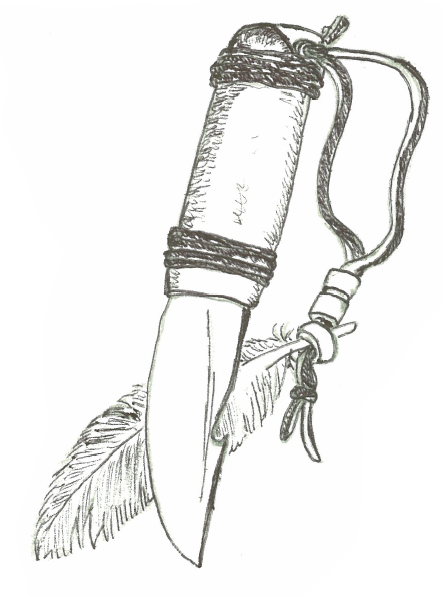
A few days later, Charlie gave me a knife.He'd never given me anything before, and though he hadn't it over to me with very little fan-fare, I'd hung around Kit long enough to understand the significance of such a gift from a teacher. It was a little utility knife, with a thick, sturdy steel blade about four inches long, with a notch in the top so it could double as a skinning knife. The full tang was sandwiched between cut sections of bone to make a smooth handle, oval in cross-section, and the exact size for my hand. I suppose the bone must have been glued, but it was also wrapped around a few times at the front and back with thin, rawhide strips. The tang poked out the back in a loop of metal and Charlie had tied a loop of leather thong to it, closing the loop with a few wooden and bone beads and an owl feather. A sheath went with it with its own loop of beaded leather and a little bone hook so I could attach the knife to the sheath if I wanted to. But the sheath was made of deerhide, with the hair still on it, lapping out and covering the rough sinew seam. The whole thing, except the steel blade and tang, was obviously but expertly handmade, made of deerhide and bone.

"Charlie, is this--?" I began.

"Yes," he told me.

[Note; when Charlie spoke of being apprenticed to reality he was quoting the writer, Gary Snyder, from memory and a little imperfectly. He did not intend the phrase to be mistaken for his.]

[Next Post: September 16th: Interlude] 

Sunday, September 8, 2013

Part 5: Post 12: Trees, Finally


He can read Latin for pleasure, but evidently Charlie can’t drive. Did I mention this? Or, he can drive, but he really shouldn’t. 

As I said, we’ve been going on a lot of field trips for Messing Around Outdoors—obviously, we’ve got to get outdoors in order to mess around—and most of them are either on campus or something we can bike to. I’ve never been to any school where we biked to field trip locations, even if they were fairly close by, but they do take avoiding using gas seriously here.  Not that I’m complaining at all—biking around the countryside in this gorgeous Fall weather so we can go take a walk in some unusual woods or muck about in some little creek or wetland for an hour or two is not at all a bad way to spend the day. I don’t know what they’d do if a student couldn’t ride a bike, though. Take different field trips, I suppose.


But a few times we have traveled by vehicle. I forget if I’ve explained this, but all the campus vans and cars run on veggie Diesel, which we make on campus using fry oil donated from local restaurants, so we didn’t actually have to use any gas at all. We piled into a fifteen passenger van and Charlie drove. And he drove very badly. I don’t mean he was swerving all over the road or did anything deliberately stupid, he just didn’t seem very good at it. He keeps well under the speed limit, misses turns and has to go back, and comes very close to running red lights, apparently because he didn’t notice they were red. He will not talk to anyone else while driving, apparently because he needs to concentrate, but he talks to himself, under his breath, like he’s trying to talk himself through something. It’s terrifying.

I think the issue is that Charlie drives so rarely that he’s forgotten how to do it.

He makes no attempt to hide the fact that he can’t drive well—he doesn’t bother with excuses—but he also does not seem embarrassed by it. He takes no apparent notice of the issue at all. And none of us are going to say anything.

Anyway, Fall is proceeding the same way Spring did, in little progressive fits and starts, so that every week or two I think yeah, Fall is really here now! And then a week or two later I think the same thing again. This past week, walking around campus, the sky has been this rich, crystal blue that seems to come all the way down to the ground. The trees haven’t seriously started to change yet, it’s not “foliage season,” but I’ve been paying a lot of attention to trees lately, and I think they’ve gone a sort of yellowish green now.

And speaking of paying attention to trees…I keep labeling them. I’ve started bowing to them when I greet them to label them, a habit of showing respect that I picked up in martial arts class this past summer. I don’t know, it just feels right. Since Charlie’s been asking about specific trees I’ve been paying even more attention, trying to remember everything I’ve noticed over the summer about each tree, noticed without noticing, and reading up on each tree and each thing I notice using the books from the library and the herbarium. I don’t try to memorize any of this; I just sort of soak it up, so it will be there, in the part of me that knows more than I do, when I need it. I had stopped thinking about when this labeling project would end a long time ago. 

So you can imagine my surprise when the tree-labeling project ended today.
White Oak twig and leaf

As I’ve explained, Charlie had been going around unlabeling trees in the morning, leaving me to re-label them during the day, so he could inspect my work in the evening. He maintained the fiction that I just hadn’t finished labeling the trees on campus, but was controlling the duration of the project by always unlabeling slightly more trees than I had time to re-label so I could never catch up. I’d get angry about this sometimes, but there was no point in that, because of course I was free to quit any time I want; Charlie can’t make me do anything I don’t want to do, but if I want his help I need to accept the help he decides to offer. So I just did it, labeling trees, over and over, each one with its common, English name and it’s scientific name, spelled correctly, in Latin.

Lately, I’d noticed that he was letting the margin shrink, unlabeling fewer trees, letting me catch up. I didn’t think he’d actually let me catch up, so I didn’t have any particular feelings about it. I didn’t see the light at the end of the tunnel because after weeks of trying like mad to solve this puzzle and failing I’d stopped looking for it. So the other day when I actually labeled all the unlabeled trees I’d found I was mildly surprised, but I figured Charlie would do something to take success out of my reach again. And, sure enough, when I saw him around eleven that morning, he changed the rules of the game again. He was reading his Latin Pooh book again, almost done with it, and he barely looked up when I greeted him.

“I’m checking the trees early today—before class,” he told me, in an offhand way, “so you might want to hurry up and make sure they’re done.”

“Charlie, I think they are done,” I told him, without much hope. That made him look up.

“You think? Daniel, you can be wrong, but do not be less than confident.”

“Alright, they are done. I labeled them all this morning.”

Pileated Woodpecker hole
“Nope. Six of them are not labeled. The black cherry with the missing limb from the storm this past spring, the pin cherry being shaded out by hickories, the white oak with the Armillaria root rot, the white pine with two old pileated woodpecker holes, the service tree next to the hawthorn that the shrikes use, and the willow that stump sprouted forty years ago. Go to it.”

I sighed and got to it.

And the thing is, it took me less than an hour to get all six because I knew which trees he meant. I didn’t have to search for them; I just needed the time to walk across campus several times. I didn’t have time to get lunch, I just grabbed an apple on the way to class, but I got them all done and headed to class—Charlie’s class. I assumed he’d unlabeled more trees and that he’d have more specific directions for me to follow to unlabeled trees later. After class, he called me over.

“Did you do it?” he asked me.

“Yes, I did.”

“Alright. Good job.”

“What?” I asked, confused.

“Good job! I asked you to do something and you did it. Thank you.”

I stood there stupidly. He was fussing with papers on his desk, but when I didn’t leave he looked up at me.

“You’re done! Now go on, go get dinner. I know you’re hungry.” Numbly, I went.

I know I should be happy. He must have been watching for me to learn something, and now he’s judged that I’ve finally learned it. So I did it. I’m pleased. I feel proud of myself. But that’s not all of it. I also feel…I don’t know. Strange.

What am I going to do now that I don’t have to label trees?

[Next Post: Friday, September 13: Hunting]

Thursday, September 5, 2013

Part 5: Post 11: No longer a Teenager


Today is my birthday. I am twenty years old.


Technically, I suppose, eighteen is the bigger deal, but I really didn’t think of it that way. Nothing much changed for me, in a practical way. I could vote, but I didn’t. I had to register for Selective Service, but there’s no draft. If I got arrested I’d be arrested as an adult, but I didn’t do anything to get arrested, so I wasn’t worried about it. I started my senior year of high school and life went on as before.

But now I’m not a teenager anymore. It’s silly, just a meaningless trick of language, but I’ve been thinking of myself as a teenager for…obviously seven years, which doesn’t sound like a long time, but it feels like most of my life.

I went home last weekend to celebrate with my parents and some of my friends there. We didn’t have a big party, because we couldn’t get everybody together at the same time, but I went out to eat with my mother and both siblings one night, and my Dad and my brother and his wife the next night. And I hung out with some of my old high school friends during the day. It was awkward—it seems like every time I go home I have less in common with my old friends, even the Wiccan ones, which is just bizarre. But we had a good time anyway, and it was really good seeing my family. My brother is a lot older than me and I hadn’t gotten to see him in a long time.

And I got presents. I usually don’t make a big deal about presents—I like opening them up, the surprise of the thing, and seeing what my family and friends got me, but I’m not really into “loot” for its own sake. Except this year I was more excited about it because I’m basically broke, and there are things I can’t get for myself. I mean, I sold my car last February, but that money goes to pay for my room and board fees here. I didn’t take any out for my own use. I have some money saved up from my job with the landscaping company when I was in high school, and I don’t need very much—I spend less than twenty dollars a week, on average, but—my income is zero and I really don’t want to ask for money from my parents. So I asked for books instead.

Yellow Fly Agaric
I now have my own collection of field guides. Most of them are Peterson’s Guides, because I like the line drawings. They really look like what they’re supposed to look like. So I have Shrubs and Trees, Trees (yes, there is overlap, but they each have species the other doesn’t, so I asked for both), Edible Wild Plants (maybe I won’t be so dependent on Rick for Paleolithic Dinner), Ferns and Fern Allies, and Grasses. I asked for Newcomb’s Guide to Wildflowers, because it’s easier to use than Peterson’s once you get the hang of it. I also got a guide to bird’s nests and a really nice one for mushrooms, not that Charlie has sent me after mushrooms yet, but I figure it’s just a matter of time. I have my own hand lens now, which seems to be more or less required for identifying anything that can’t run away. Seriously, I’m bizarrely proud of my little hand-lens. It has two lenses that each fold into a little metal handle half the size of my thumb and hangs on a leather lanyard around my neck. I got a book on stargazing and one on insects, too, even though I didn’t ask for them, and they are both quite nice. And I didn’t ask for them, either, but my Dad got me a Bible and a book by John Wesley. I think he’s worried that I’m going to lose my faith among the pagans or something, and I suppose that’s kind of intrusive, but I don’t really care. I haven’t had my own Bible since the children’s study Bible I got for Sunday school when I was a kid. So all in all, I feel very grown up, equipped as I am with the texts of science and religion.

The very thought, “I feel so grown up” is about as childish as you can get, of course, but I don’t much care. I’m having fun.

I didn’t make a big deal of my birthday on campus—some people do, even having someone announce their birthday after breakfast, so everyone can clap and sing Happy Birthday, but I didn’t really feel like it. Basically, I don’t like a lot of people paying attention to me, not all at once like that. But I did mention it to Ollie a while back, and so he, Willa, Rick, Joanna, Nora, Kayla, and Arthur all took me out to dinner in town. I bought a piece of chocolate cake for dessert and blew out three candles and let everybody take a bite. I got most of the icing. It was nice.

At dinner, Rick asked me if I’d invited Charlie, since he wasn’t there. Of course, I hadn’t invited anybody, Ollie invited everybody, and he isn’t friends with Charlie so he didn’t think of it, but honestly I’m not sure I would have thought of it, either. Am I friends with Charlie? I don’t know. He’s harder to get to know than a tree or a forest.

Speaking of Charlie, I’m wondering if he’s just had a birthday too, or something. He’s got a new book. I saw him sitting on the Mansion porch the other day, smiling in the sunshine, one sandal on and the other nowhere in sight, happily reading the beginning of this new book. He saw me looking at the book, curiously, so he held it up so I could read the title.

It was a translation of Winnie the Pooh in Latin.


[Next Post: Monday, September 9th: Field Trips]

Sunday, September 1, 2013

Part 5: Post 10: Class Interactions


Labeling trees has become such a routine for me, I really shouldn’t be too surprised that Charlie would start making it harder.  The other day, when I joined him for lunch, he casually mentioned that the white oak where the woodpecker nest had been had lost its label (as though he had nothing to do with the label being lost) and had I relabeled it yet? Of course, I had re-labeled a number of white oaks, so I probably had gotten the one he meant, but that obviously wasn’t what he was asking. He wanted to know if I’d noticed the woodpecker nest.

Female Downy Woodpecker
“I don’t know,” I told him. “What does a woodpecker nest look like?”

“You wouldn’t have seen it,” he corrected me, “but you might have heard it.”

I have learned that trying to answer these kinds of questions with my conscious mind is useless, they’re designed that way. But sometimes the answer comes to me if I let it. What I could not do was simply tell Charlie I didn’t know, as if the question didn’t matter. Even though I had not thought the question was remotely important before Charlie said anything. I closed my eyes and wandered around in my memory, listening for the rasping cheep of baby birds.

“You mean the big one with the limb fallen off of it?” I asked, opening my eyes. “Yes, I got that one.”
He smiled slightly and briefly and went back to reading a newspaper. After a few minutes he put his newspaper down and we chatted about other things for a few minutes—he asked me if I’d ever been hunting before, and when I said I hadn’t he asked if I knew how to shoot. He meant with a bow. I told him I’d been pretty good at archery in camp when I was a kid and he said we should go shooting together and see how good I actually am. I figured he was just making conversation, trying to distract me from whatever he was up to with the tree labeling.

And since then almost every day he asks me a question like that—did I get the black cherry with the three tent-caterpillar nests in it? Did I get the white pine with the lightning strike scar? I could say I don’t know and leave it at that, but I can’t bring myself to do that. It would disappoint him. And anyway, making me do insane things I wouldn’t do on my own is exactly what I asked him to do from the beginning. So I’ve just got to pay a lot more attention.

In any case, the semester continues. Each class has met six times now, and the strange thing is it’s like they’re talking to each other. I don’t mean the teachers talk to each other, though obviously they do sometimes, I mean that the subjects of the four classes I’m taking interact with each other and form an odd sort of whole.

I wouldn’t be surprised that Charlie’s classes relate to each other, except that a lot of people taking one class aren’t taking the other one—and a lot of the overlaps are surprises. Like, the other week in Environmentalism for Dummies we covered exotic organisms and one of the two case studies we used was the story of the chestnut blight. It’s a very sad story, and something I’d never really thought of before—that the woods I know are not the same woods as grew a hundred years ago, that they’re reduced in some fundamental way. American chestnuts used to be really common and really important trees, and they’re just gone now, not that they’re extinct—they aren’t—but there are so few of them now that they forests they helped create are gone. It’s a new and poorer forest now. There’s this shadow of loss across the entire eastern part of the country and I just never noticed it before. Then, the next Friday we went off campus in Messing Around Outdoors and went for a walk up a small hill Charlie knows about. Some of the leaves, mostly green but with yellowish edges, are starting to fall. I can’t tell if they’re the first fallen leaves of autumn or just the sort of leaves that come off randomly in summer, or even if the question makes sense at all. Anyway so we were walking along, and suddenly Charlie stopped talking, reached down, and picked something up. It was an American chestnut leaf.

American Chestnut Leaf

The other classes interact, too. Charlie talks about scientific method and uncertainty—how when scientists say they can’t prove this or that it doesn’t mean people shouldn’t take their warnings seriously—and I think about something Allen was saying about statistics in relation to something completely different, and the lights go on. I just suddenly realized that scientific uncertainty is different from regular uncertainty, because the degree of uncertainty can be known. Regular uncertainty is just the absence of emotional certainty, which is wrong half the time anyway. So when scientists say they are sure enough that global warming is real, that means a lot more than an ordinary “kinda sure.”

And then Charlie shows us a paper wasp nest hanging from a tree and I think about self-organizing
Paper Wasp Nest
systems from Complex Systems class. Or we cover entropy in Complex Systems and then the next week in Environmentalism for Dummies Charlie mentions the same concept in relation to the extinction of species and what he says makes so much more sense.

They couldn’t possibly be planning this. I mean, if there were only four classes that all of us were taking they could plan it, and maybe they did for Spring semester when most of us were taking the same classes, but now it would be too complex. We have too many options, there are too many patterns for them to keep track of and orchestrate.

But I don’t think it’s random, either. Or, it’s not random in the ordinary way. It’s the sort of thing that happens all the time around here. Things just work out. The right conversation happens at the right time, enough money shows up just when it’s needed, the coincidences all work the right way. Kit would say it’s no coincidence. Allen would say it probably is coincidence—if you studied it properly all these things would probably be entirely consistent with what’s expected by chance. But Allen would also ask why something that is random can’t also be meaningful.

And so I go to my classes and I label my trees. I’ve started bowing to them to show respect, a tendency I picked up in martial arts class over the summer. It seems like the right thing to do.

 [Next Post: Friday, September 6th: My Birthday]